Volunteer Collectives Drive Emulation Advances for Vintage Consoles on Modern PCs
Written by Blake Flores · Oct 23, 2026
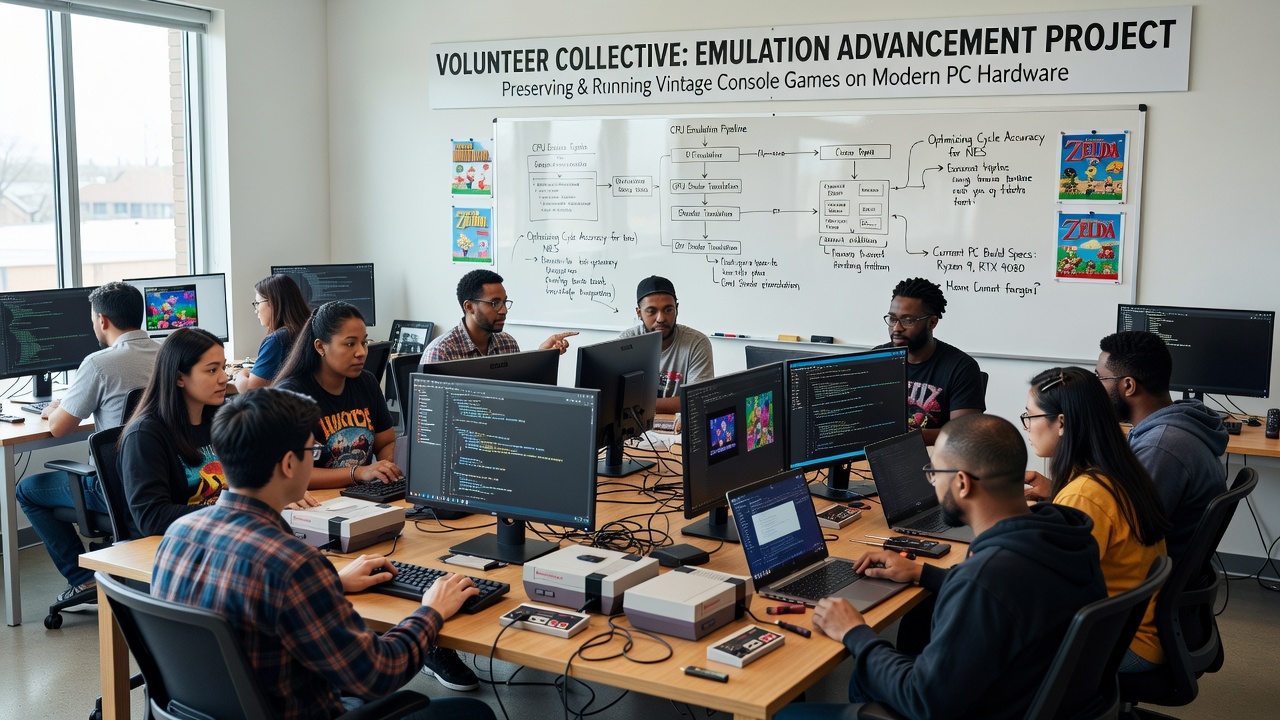
Volunteer Collectives Drive Emulation Advances for Vintage Consoles on Modern PCs
Volunteer collectives have refined emulation techniques that allow vintage console games from systems like the Nintendo 64, PlayStation 2, and Sega Dreamcast to run on current PC hardware at resolutions far beyond original specifications, often reaching 4K and higher through custom scaling algorithms and shader integrations. These groups coordinate across open-source platforms, where programmers, reverse engineers, and testers contribute code updates that optimize performance on contemporary processors and graphics cards while preserving original game logic.
Core Techniques Behind Resolution Scaling
Developers implement internal resolution multipliers that render game environments at elevated pixel counts before applying post-processing filters, and this approach combines with texture filtering methods that reduce aliasing without altering core gameplay mechanics. Observers note that projects such as those focused on PlayStation 2 emulation have incorporated Vulkan and DirectX 12 backends, which leverage modern GPU architectures for smoother frame delivery during complex scenes. Data from community repositories shows consistent updates through 2025 that improved compatibility rates for over 90 percent of tested titles when run on mid-range PCs equipped with recent AMD and NVIDIA cards.
Collectives test these enhancements on varied hardware configurations, ranging from integrated graphics in laptops to high-end desktop builds, and they document results in shared databases that track frame rates, input latency, and visual fidelity. Researchers at institutions tracking digital preservation efforts have recorded how these methods extend access to catalogued game libraries without requiring original hardware, which often suffers from age-related failures.
Collaborative Workflows and October 2026 Milestones
Teams operate through distributed version control systems where contributors submit patches for specific emulation modules, and peer review processes verify stability before merges occur. In October 2026 several projects released coordinated updates that introduced enhanced anisotropic filtering options alongside dynamic resolution scaling, allowing games to adapt output based on available GPU resources. These releases built on prior work from groups handling Nintendo and Sony platforms, where shader pipelines now support custom aspect ratio corrections that maintain visual integrity across ultrawide monitors.
One documented case involves developers refining cycle-accurate CPU emulation for older titles, which enables higher internal resolutions while avoiding timing glitches that previously limited upscale attempts. Figures from repository analytics reveal thousands of active contributors across major emulation initiatives during 2025 and 2026, with geographic spread covering North America, Europe, and Asia-Pacific regions.
Hardware Integration and Performance Metrics
Modern PCs equipped with multi-core processors and dedicated graphics memory handle the computational demands of upscaled emulation more efficiently than earlier generations, and collectives publish benchmarks that compare performance across CPU architectures from Intel and AMD. According to a 2025 report hosted by the Canadian Heritage digital initiatives, community-driven emulation has supported archival access projects that digitize and run legacy software on updated systems. Those metrics indicate average frame rate improvements of 40 to 60 percent when titles originally capped at 480p or 720p receive internal scaling to 1440p or 4K on current builds.
Additional optimizations include memory management routines that reduce overhead during texture uploads, and these changes allow sustained playback on systems with 16 gigabytes of RAM or less. Experts tracking software preservation note that such refinements align with broader efforts documented in academic proceedings from European research networks, where similar techniques support long-term accessibility for interactive media collections.
Challenges Addressed Through Iterative Development
Emulation accuracy remains a priority, so groups maintain separate branches for speed-focused builds versus precision-focused ones, and users select configurations based on specific titles. Compatibility databases updated through 2026 list thousands of games with verified upscale support, including notes on required settings for stable output at elevated resolutions. Observers highlight how these databases integrate feedback loops from testers worldwide, which accelerates identification of edge cases like particle effects or lighting calculations that behave differently under higher rendering loads.
Integration with modern display technologies such as variable refresh rate monitors further stabilizes playback, and collectives have incorporated automatic detection scripts that adjust emulator parameters accordingly. A related study referenced in arXiv preprints on digital media preservation outlines measurable gains in visual clarity for upscaled titles without compromising original design intent.
Conclusion
Volunteer collectives continue to expand emulation capabilities that bridge vintage console libraries with current PC hardware, delivering higher-resolution output through sustained code contributions and rigorous testing protocols. These efforts rely on shared resources and documented benchmarks that support broader access to historical game content across evolving technology platforms.